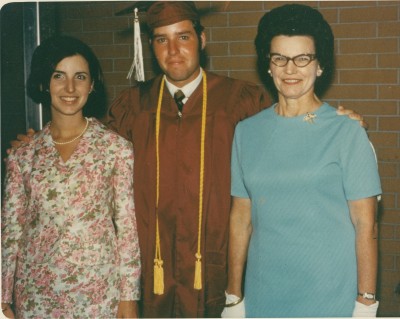
My family has a three generation history of delivering commencement addresses. First, my Nana was the valedictorian of her Batesville High School (now South Panola High School) Class of 1933. In 1966, my mom delivered her commencement speech, What I’ve Willed I’ll Do, at Tarpon Springs High School. In 1969, her brother and my uncle Michael, was the commencement speaker at his graduation from Tarpon Springs High School. Finally, in 1984, I was selected to be a commencement speaker at my graduation from Thomas Junior High School (now Thomas Middle School).
A couple of years ago I transcribed my mom’s graduation speech on my original blog. This year, I presented her original speech to her along with her commencement program as part of her Mother’s Day gift. I found the speech and the program while cleaning out Nana’s house and have been waiting for the right moment to give them to my mom.
At the same time I found my mom’s graduation speech, I found the one delivered by my Uncle Michael and I share it below because I believe he’s got a terrific message about creating a legacy and making the world a better place. I share it exactly as he wrote it – typos and all.
Graduation Speech by Michael E. Paulk, June 6, 1969, Tarpon Springs High School
Mr. Wright, faculty members, mothers, fathers, and finally but most important of all, fellow seniors. We, who are graduating tonight, are about to set sail upon the greatest adventure of our lives. The greatest because, this adventure is our Life. This adventure will end only when God calls us to him again. But before that time there will be numerous ports-of-call.
As we embark upon this adventure, there seems to be one question that is always asked, “What will we do with our lives?” Will we be shanghaied into some backwater port, where the ships are rusty and their hulls green from slime in the water? or will we sail, with all sails full and thug before the wind, into Wakiki Bay, and anchor among trim hulls, with woodwork freshly painted, and metalwork freshly burnished? We are at a time in life where we must choose which way to steer. As Shakespeare wrote in his play Julius Caesar,
There is a Tide in the affairs of men,
Which, taken at the flood, leads on to fortune;
Omitted, all the voyage of their life
Is bound in shallows and in miseries.For twelve years now, our teachers and parents have been teaching us what they have found useful in plotting the courses of their lives. They have tried to teach us how to navigate, not only the calm seas of life, but also the tempest tossed, the rock strewn, and the shoal cluttered seas that we will have to cross.
Needless to say, we will not all steer the same course in our passage. Some of us will become doctors or plumbers, some ministers, or soldiers, and some scientists or businessmen.
Each of us, as the saying is, will be “doing our own thing.” But we should not do our own thing only for ourselves. William James once said, “The greatest use of life is to spend it for something that outlasts it.” And Louis O. Caldwell wrote, “Everyone needs to be gripped by a deeply absorbing purpose that will give direction, power, and meaning to his life. A meaningful life becomes possible when a person believes that his activities and relationships are directly and vitally connected to the goals he values. Ambition and responsible behavior result when these goals seem supremely worthwhile and attainable.”
What goal can each senior of 1969 set for himself? Some of you would promptly say, “That’s an easy question to answer. Fame and fortune, of course.” But let us remember the words of Kipling, spoken to a graduation class in Canada. “Don’t put too much emphasis on fame and fortune. Someday you will meet a man who needs none of these things, and then you will know how poor you are.” Another reason why just fame and fortune should not be set as a goal for our lives was given by Horace Mann, who is called by many the Father of the American Public School System. He once said, “Be ashamed to die until you have won some victory for humanity!” This is not to say that fame and fortune cannot be a victory for a humanity. For fame and fortune as earned by Doctor David Livingstone, George Washington Carver, or <there’s a blank here in the original>, were indeed victories for humanity. But when one puts the acquirement of personal fame and fortune before mankind’s needs, he is fighting against humanity, not for humanity.
There is one thing though, that each of us, whether we become a doctor, a businessman, or a carpenter, can all set as a goal. That is universal peace.
“London Bobby and man jumping from bridge.”
Increased mechanization of life.
Racial strife.
Population explosion and food shortage.
Lawlessness.
Word-wide unrest, communist aggression, threat of thermonuclear war.
Both jumped off bridge.Our world is in pretty bad shape. Mankind, today, is on the verge of conquering outer space. In just two months he will be standing on the moon, a few years later, the planets, and just a few years after that, he will be aiming for the stars. With the destructive power man now possesses, and with the destructive power he gains each day; if he does not solve the problem of peace on this planet, he will merely stay the destruction of this planet and himself, to destroy the whole Universe and himself.
What is this peace that is so essential to the continuation of mankind? The Funk and Wagnall’s New College Standard Dictionary defines peace in this manner: “Peace (noun) 1. A state of quiet or tranquillity; freedom from disturbance or agitation; calm; repose. 2. Specifically, absence or cessation of war. 3. General order and tranquillity; freedom from riot or violence. 4. A state of reconciliation after strife or enmity; peaceable or friendly relations; agreement; concord. 5. Freedom from mental agitation or anxiety. 6. Spiritual content.”
This then is what mankind must attain. But what can we seniors do to help in the quest? Of the many things we can do, tonight let us think on three.
First, as John F. Kennedy once told us; “Ask not what your country can do for you, but ask what you can do for your country.” Second, we can heed the words of advice given to us by Joseph Addison, “make perseverance your wise counselor, caution your elder brother, and hope your guardian genius.” And third, we can do as the great Phillips Brooks once said, “Oh do not pray for easy lives. Pray to be strong men and women. Do not pray for tasks equal to your powers. Pray for powers equal to your tasks. Then the doing of your work will be no miracle; but you will be the miracle.”
If we heed these three, we will be spending our lives for something that outlasts it. And we will win universal peace.
In closing let us think upon, ——-no,—— let us be challenged by these words of John F. Kennedy:
Today, my uncle is the father of two grown sons, Jesse and Ryan, and a doctor who saves lives. I’d say he’s fulfilled his goal of creating a legacy and making a difference in the world.
_________
Quotes from:
President Kennedy quote about asking what you can do for your country from his January 20, 1961 Inaugural Address.
President Kennedy quote about peace from the September 20, 1963 Address to the General Assembly of the United Nations in New York.
Like Little Merry Sunshine on Facebook, follow me on Twitter and Pinterest, and see my pictures on Instagram to keep up with the latest goings on.
You can also receive immediate notification of each blog post by typing your email address in the box below and clicking the “create subscription” button. My list is completely spam free, and you can opt out at any time.
 Jessica L Gardner
Leave a comment