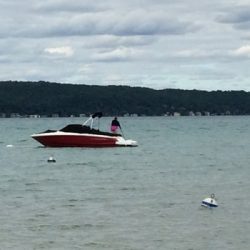
As I do every August, I spent last week at Watervale. As my dear friend Woodlawn Wonder has dubbed it, Watervale is my “ancestral family home.” It’s not, but it might as well be because there’s no other place I feel at peace or as connected to myself. I’m also the third of four generations of my family to vacation there. Simply put, Watervale is my personal slice of Heaven.
As always, my 10 days flew by. I kayaked, read four books, hung out with friends I’ve had for 30 plus years but only see in August, watched the Persiads meteor shower, did some hiking, napped, ate delicious food, visited the Upper Peninsula for the first time, picked blueberries, shopped at a couple of roadside farm stands, watched gorgeous sunsets, played in Lake Michigan, watched Dave kite board, and meditated. It was obviously a miserable trip and I had no fun whatsoever.
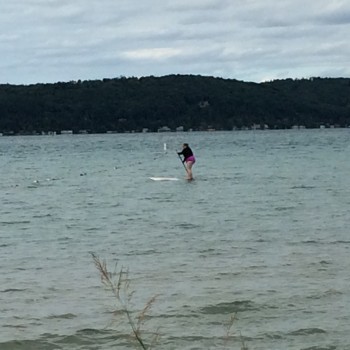
For the past few years I’ve wanted to learn to paddle board, but for one reason or another, it hasn’t fit into the week. This year, however, I was not going to be stopped. On Sunday afternoon, Dave and I grabbed Linda’s paddle board and headed over to Crystal Lake where in less than 90 minutes I conquered paddle boarding and cruised around the lake on my own.
In the process of learning to paddle board, I realized that my success in learning to paddle board required the same skills as being successful in life and business.
How? I’m so glad you asked . . .
- Find a coach you respect who respects you, as well. If your coach doesn’t treat you with respect and dignity, keep his/her word, understand his/her own weaknesses, and is unable to meet you where you’re at, find a new coach. My coach in learning to paddle board was my brother Dave, a master kite boarder, kayaker, wind surfer, paddle boarder, and very strong swimmer. I respect his knowledge, skills, and general acumen for sports on the water. Dave knows the kind of feedback that I respond best to and he gives his feedback in that manner. When teaching me a new skill or helping me push myself to achieve a goal, he’s never belittled me or given me grief because I don’t have his natural athletic abilities.
- Be coachable. I was open to learning and improving, never took Dave’s feedback personally, and took immediate action on his feedback. On the flip side, Dave gave actionable feedback that let me know what I was doing well and how to improve without attacking me. He didn’t wait until I’d fallen down 10 times to share how I could improve.
- Ask for feedback that’s immediate and actionable. “Great job!” or “you need to get better” isn’t feedback when you’re learning a new skill or trying to build an existing muscle. While I may be able to quickly interpret the former, odds are good that I’m not going to know exactly what it takes to “get better.” Dave would say things like, “Great job in getting up on the board. Now try shifting your left foot forward a couple of inches so that your feet are parallel and you can more easily balance your weight and remain on the board.” From this statement, I know exactly what I did well and how to improve.
- Remember that Weebles wobble, but they don’t fall down. If you are a Gen Xer, like I am, you remember Weebles. If you aren’t a Gen Xer, I’m sorry, but you can learn about Weebles here. I can’t begin to tell you how many times I fell off the paddle board and it doesn’t matter. What matters is that each time I fell off the board, I popped right back up and tried it again.
- Be confident. The importance of self-confidence cannot be overstated. As I was trying to master paddle boarding, I could feel that the moment my confidence waned, I’d fall off the board. When a wave came towards me, as long as I stayed strong in my conviction that I knew how to navigate the wave and stay on the board, I was fine and I’d stay up, but when I doubted my ability, I’d fall. I wasn’t arrogant; I was confident. Sometimes I actually (quietly) talked myself through the wave. “I know what I’m doing,” “breathe,” and “stay perpendicular to the current” were frequently repeated to myself.
- Be fully present. Research tells us that multitasking makes us less efficient and reduces our performance. In my own life, when I’m fully present, I learn and work faster and my accuracy is close to 100%. When I’m not fully present, I miss things and I make mistakes. As I was learning to paddle board, I blocked out all distractions and focussed only on my immediate task at hand. I wasn’t playing on my phone. I didn’t pay attention to the people on the beach and worry that they were laughing at me (they weren’t). I barely noticed the storm clouds that began to threaten my fun; I only paid enough attention to them to listen for thunder and lightning.
- Look forward, not backwards. When I was first trying to get up on the paddle board, I kept looking at my feet and kept falling off the board. I might get up and paddle 10 feet or so, but I’d fall very quickly. Dave suggested I keep my head up and my eyes focussed on what was in front of me rather than on my feet. As soon as I made this change, I was able to paddle further. Once Dave yelled an instruction to me when I was about 50 feet away from him. I turned my head towards him and immediately fell off the board. From that moment on, when he’d yell an instruction to me, I kept my eyes looking ahead and made the adjustment he suggested without turning my body. This enabled me to keep moving forward even as I changed my approach.
- Focus on what’s going right. To me, this is simply common sense. In anything in life, if I focus only on what I’m doing wrong, inevitably, I keep repeating my mistakes and I never move forward. When I focus on repeating what I’m doing right, I move forward an achieve success. Dave knows that about me and tailored his feedback to help me focus on what I’m doing well. Rather than barking at me because I kept falling off the board (spoiler alert: every newbie paddle boarder does this), he would say things like “you stayed up longer that time” or “you did a great job of making more subtle adjustments rather than making sudden big moves.” That’s not to say that he didn’t tell me what I did wrong, but he didn’t harp on it.
Do you enjoy reading Little Merry Sunshine? Of course you do.
All the cool kids sign up for the email to alert them of new posts and follow LMS on social media:


 https://widget.bloglovin.com/widget/scripts/bl.js
Enter your email address in the box below and clicking the “create subscription” button. This is a two-step process, so look for the confirmation email and click on the link. My list is completely spam free, and you can opt out at any time.
 Jessica L Gardner
Leave a comment